The best way to get a closer look at (and a firsthand account of) the sport of jiu-jitsu? Get yourself choked by a brown belt

(This piece appeared in my now defunct fight blog, Pinoy Fight Scribe, in 2013.)

by Mark Lorenzana

My friend Jasmine earned her degree in Accountancy, cum laude, at the University of San Carlos in 2006 and her degree in Law at the University of the Philippines–Diliman in 2010. As a certified public accountant and an attorney, she currently works as a Junior Associate specializing in litigation, tax and corporate advisory, and corporate housekeeping at a high-profile law firm in Makati. But when she’s not being a CPA lawyer, you can find Jasmine in a gi, on the mats, trying to choke people out. Jasmine, who has a blue belt in Brazilian jiu-jitsu, took up the sport a few years ago when she decided that she needed to lose some weight. Now, aside from successfully shedding off the extra pounds, she’s also quite adept at—to put it mildly—making her opponents tap out on a regular basis.

“I used to run, but I noticed that I wasn’t losing as much weight as I wanted to,” Jasmine tells me one warm Sunday night at the Cebu branch of the jiu-jitsu gym she trains at, in between training sessions. “My first day doing jiu-jitsu, I was lying in a pool of my own sweat. That’s how intense the training was.”

I see what she means. I look around and about ten pairs of trainees, their gis all soaked in sweat, are getting busy on the mats, changing their positions and holds as Norman, the head instructor, belts out instructions.

“Kimura!” Norman yells in a booming voice. “Choke! Arm bar!”

Norman, who has earned his brown belt early last year, is all business. And as he keeps on belting out instructions to his students, he sounds like a man on a mission. “Pick up the pace, execute right away!” Norman shouts. “Let’s go, a little bit faster. Move faster!”

The arm bar may very well be the most frequently used joint-lock submission in mixed martial arts (MMA) today. This particular submission is commonly performed by placing your legs across your opponent’s chest, with one of his or her arms positioned between your thighs and with the elbow joint against your hips. From this position, you will grab your opponent’s arm and position his or her forearm against your chest. When you lean back and arch your hips, you create intense pressure in the elbow joint, which forces your opponent to tap out. If the tap doesn’t come soon enough, the results can be nasty: torn ligaments and torn tendons in the elbow joint. In fact, it is not rare in some cases for the arm bar to result in a broken bone if there is sufficient leverage, power, and angle.

On the other hand, the kimura—which is named after its inventor, Masahiko Kimura, widely considered as the greatest judoka of all time—is a submission that essentially involves cranking your opponent’s arm away from him or her, which puts intense pressure on the shoulder and elbow joint, resulting in the tap. Of course this is the most simplified description of the submission as it can be—like most submissions in jiu-jitsu—executed from almost any position and angle.

In the case of chokes, Jasmine explains that there are actually two different types: a blood choke and an air choke.

Blood chokes work by compressing the carotid arteries, therefore cutting off the supply of oxygen to the brain. A properly executed blood choke can render a person unconscious in as little as three minutes. Air chokes, in contrast, cut off air flow down the trachea. As such, an air choke generally relies on strength rather than technique to be effective. Air chokes are typically inefficient or ineffective for use in martial arts. And besides, air chokes are extremely dangerous and can cause major damage to an opponent—they can actually fracture a person’s larynx.

There are quite a few blood chokes employed in Brazilian jiu-jitsu and MMA, but the most common is the rear-naked choke. Out of curiosity, I ask Jasmine how to do a properly executed rear-naked choke.

“Why don’t you show him so he knows what it feels like?” Norman, who has overheard our conversation, says.

* * *

“When you choke someone,” Norman tells me while I’m seated on the mat, with him behind me, “you’re basically cutting off blood supply to the brain. That’s why you pass out.”

He adds, “A rear-naked choke works like this. What I’m doing right now, what I’m doing is that I’m wrapping my arm around your neck like so, and then I put my other arm over the other arm like this and behind your head to try to cut off the blood supply. What you feel right now is that I’m not actually choking you yet. If you do feel a bit of sensation where it feels like you are losing a bit of light in your vision, that’s basically you panicking. At this point. Don’t worry about it, don’t tap just yet. Just relax. Now I’m just tightening it just a bit slowly. Feel that?”

“Yes,” I say.

“I don’t even need to tighten it suddenly,” Norman says. “I just have to count from one to ten and each count it’s going to be tighter. So why don’t we do this? Why don’t we count to five, don’t tap, and let’s just see if we can reach five before you fall asleep. Okay? Okay.”

“One.”

Before I could protest, I start to feel Norman’s arms tighten around my neck, a predator squeezing the life out of its helpless prey. Instinctively, I move my hand next to the forearm that’s cutting off blood circulation to my brain, ready to tap.

“Two.”

I could feel the blood draining from my face, my vision blurring, everything starting to turn black. The telltale signs someone feels before passing out.

“Three.”

I tap Norman’s forearm furiously, my hand slapping as hard as I can before I completely lose consciousness, which—in my estimation—won’t be too long from now.

“Four.”

Surprisingly, by this time, the urge to keep on tapping is replaced by a feeling of utter surrender, of complete helplessness. I feel my arms go limp. Then my entire body. By now the room is almost completely enveloped in darkness. At once falling asleep doesn’t seem like a bad idea after all. And at this point, believe it or not, it’s as if you welcome it. Sleep beckons. You give in to the inevitable.

Norman lets go.

“Five.”

Suddenly the floodgates to my oxygen-starved brain are opened, blood is pumped back, and the darkening gym is slowly bathed in light. I slowly regain strength in my limbs, in my entire body. I try to sit up.

“A little bit of zooming out, it’s just how that feels,” Norman says. “Now that’s a rear-naked choke. That’s how a choke feels.”

No kidding.

“Not quite but almost,” I manage to croak out, referring to the fact that I hadn’t totally passed out. And because I’m still conscious, I feel pretty good about myself. But not much—my throat feels like it’s been crushed in a vise.

“Yes, I know,” Norman says, smiling. “I let go before we reached five.”

Jasmine says she passed out once before, from a choke. “I was competing with this Korean guy, he was very physical, and he had me in a choke,” she tells me. “And he was talking so he didn’t notice I was already tapping out. Maybe I was tapping lightly so he didn’t notice. So I passed out. When you wake up, it’s like you wake up in the morning after a long sleep.”

She smiles, and adds, “It feels so refreshing.”

No kidding.

* * *

I’ve known Jasmine since our college days at USC, and needless to say, this is the slimmest I’ve seen her, ever. She also looks incredibly strong (she regularly does fireman’s carries on guys weighing 130 to 150 pounds at the gym). Jasmine loves to compete and has won bronze, silver, and gold medals in various local and international Brazilian jiu-jitsu tournaments, which include the Rollapalooza Brazilian Jiu-Jitsu Tournament, the Abu Dhabi World Jiu-Jitsu Championship Trials, and the Pan-Asian Brazilian Jiu-Jitsu Competition, among others.

Jasmine trains four days a week after work, Monday to Thursday, and also teaches an all-girls jiu-jitsu class on Saturday mornings. She tells me that if given the chance, she also plans to do cross-training in striking and eventually progress to full MMA.

Jasmine may be on to something. In November of last year, Ronda Rousey signed with the Ultimate Fighting Championship and successfully defended her UFC women’s bantamweight title against Liz Carmouche in an action-packed bout that saw Rousey survive an early standing face crank attempt by the game Carmouche, only to submit the challenger in the final seconds of the first round via arm bar.

And just a couple of months ago, at the Ultimate Fighter 17 Finale, two women also figured in a thrilling fight as Cat Zingano beat former Strikeforce champion Meisha Tate via brutal TKO in the third round in what was perhaps the most exciting bout on the twelve-fight card. It wasn’t surprising that Zingano and Tate bagged Fight of the Night honors for their efforts and pocketed fifty thousand dollars in cash.

It seems that the UFC has discovered an untapped resource for pulling in more fans—women’s MMA, which could potentially create new stars for the organization. And as the first couple of fights in the UFC involving women have shown, the ladies are more than capable of putting on a great show for the fans.

When I visited Jasmine during her training session, she had rolled and sparred on the mats with guys bigger and heavier than her. She had given those guys a hard time. At the risk of sounding clichéd, Jasmine’s current skill level on the mats is very impressive. Factoring in the numerous medals she’s won in tournaments throughout the years, everything Jasmine has accomplished as a jiu-jitsu practitioner is a testament to her hard work, dedication, and drive. Undoubtedly the same hard work, dedication, and drive that have taken professional fighters like Rousey, Carmouche, Zingano, and Tate to where they are now.

And looking at Jasmine as she practices her different submissions and holds during a break in my interview with her, and as the sport of MMA pulls in more interested viewers and practitioners, I can’t help but imagine a jiu-jitsu or MMA gym here in the Philippines dominated by hardworking and talented women in the near future.

No kidding.

“Arm bar! Choke! Kimura!” Norman screams.

* * *

“What’s an arm bar?” Norman asks me. “An arm bar,” he says, “a lot of people think that it’s dislocating the shoulder. It’s not. It might look very fancy, but you’re actually dislocating the elbow. So this is how it’s going to look like.”

Norman sits beside me while I lie down on the mat, him stretching my arm out and slowly twisting my elbow outward, a few inches away from the breaking point. He says, “I’m putting pressure. This is very simple, this is very basic, this is a very crude idea of an arm bar. I’m putting pressure on the elbow, I’m putting pressure against where it’s normally not supposed to be stretched. That’s how it is.”

Norman lets go of my arm, and he sits on my chest. “Now when I get to the mount, I grab your right arm in my right hand, I push your face away with my left hand, I go to your side, move your face to the side so I can put my foot over, just like this.”

By now Norman’s upper legs are both wrapped around my left arm as he grabs on to my forearm, making sure my thumb is pointed up and away from him. One of his calves rests on my neck, the other rests on my chest. He sticks my wrist against his chest and slowly lies down on the mat, stretching my elbow outward.

“Now this is nothing yet,” Norman says. “There’s already tension, but it’s not gonna break anything. When I bump my hips upward like so—”

I feel a sharp pain. My elbow feels like it’s about to pop.

He taps my elbow lightly with his free hand and says, “This is where it’s going to break. I’m using all my body’s leverage to break this part of your body.”

And I can feel it. It’s is a very efficient way to twist the elbow upward and dislocate or break it while, at the same time, immobilizing your opponent on the ground. With his calves pinning my neck and chest, pushing my back against the mat, all Norman needs to do is arch his back and move his hips a bit further upward, just a few more inches, so he can snap my elbow like a twig. By now I could feel an intense pressure against my elbow. I brace myself.

Norman lets go.

“And that,” he says, “is how you do a properly executed arm bar.”

No kidding.
Pinoy Fight Scribe’s Assorted Wednesday Fight Bullets

by Mark Lorenzana

(This piece appeared in my now defunct fight blog, Pinoy Fight Scribe, in 2011.)

– If you don’t like Frankie Edgar, fair enough. It’s your opinion, anyway. But you’d have to be an idiot not to admire the guy’s heart, will to win, and fighting spirit.  Just like in their first fight, Edgar got tagged early by Gray Maynard’s vicious strikes and was visibly hurt and in trouble. In fact, by the end of the first round, Edgar already appeared to be suffering from a broken nose. So what does the guy do? He sucks it all up, fights on, and knocks out his opponent cold. That’s what he did. That’s what champions do. Not to take away anything from Edgar’s win, though, but he was helped in large part by Maynard’s reluctance to let his hands go. I understand that Maynard wanted to avoid what happened in their last fight where, after putting Edgar on Queer Street, he went all out on his offense and gassed out. But I think Maynard may have been a little too gun-shy from the second round onward until the end of the fight when he got knocked the fuck out, and that proved to be his undoing. Maynard could have ended the fight in the second round if he just pounced on Edgar—fighting aggressively doesn’t mean fighting stupidly, and one can be effective by utilizing controlled aggression and not wasting punches. Anyway, so far, the two fighters have fought each other three times already: the first fight went to Maynard via unanimous decision, the second fight was ruled a draw, and now this recent knockout win by Edgar. So that’s one win apiece, one loss apiece, and one draw apiece. Will there be a rematch? I hope so. All three fights so far have all been barnburners and both guys seem to love kicking each other’s ass.

– Kenny Florian’s title-whoring didn’t pay off as Jose Aldo held on to win by unanimous decision to keep his UFC featherweight title. Florian actually started his career as a middleweight then went down to welterweight, lightweight, and now the recent cut to go down to 145. Worry not, Kenny, there’s still the bantamweight division. You can always cut off an arm and challenge Dominick Cruz for his belt. If that still doesn’t work, cut off the other arm so you can compete at 125, the flyweight division. (You just have to figure out a way to win by just throwing kicks.) Dana White said that the new UFC weight class is expected to debut next year. Good luck, Kenny! After all, if you can’t beat ‘em, go down in weight.

– “Anderson Silva, you absolutely suck,” says Chael Sonnen in the post-fight interview after submitting  Brian Stann. Silva, who was at the arena watching the fights (and who was seated next to a grinning Sir Charles Barkley) just smiled when Sonnen said this. Sonnen wasn’t satisfied, and added, “If I beat you, you leave the middleweight division. If you beat me, I’ll leave the UFC forever.” He then stormed out of the Octagon. Frankly, I can’t wait to see if Sonnen can do the same thing that he did to Silva in their last fight, where he repeatedly overpowered the Brazilian and gave him hell for five rounds before Silva  was able to submit Sonnen late in the fifth round. Sonnen has so far been the toughest opponent that Silva has faced inside the Octagon. Problem is, Sonnen’s excellent performance against Silva may have been tainted by the fact that the post-fight drug tests showed that Sonnen had elevated testosterone levels, possibly because of performance-enhancing drugs. This led to Sonnen’s subsequent suspension, which is why it took him more than a year to step back into the Octagon. I can’t wait for those two to square off again and see if Sonnen will really stick to his word to leave the UFC forever if and when he loses to Silva.

– So here’s the thing: the Donnie Nietes-Ramon Garcia Hirales fight was very close and could have gone either way. I scored it 115-113 for Nietes, giving him rounds one, two, three, four, five, six and eleven. After the sixth round, Nietes started gassing out , and that’s why he wasn’t throwing as much punches as he should have. Nietes said that it might have been the inactivity or that he overtrained or both that caused him to gas out. In any case, there are a lot of people out there that are crying about the Mexican being robbed, and I feel for the guy, of course. He came to enemy territory to defend his title and went home without it. What’s curious to me was that it was only the Filipino judge, Danrex Tapdasan, who had the score most reflective of the fight that transpired: he had it 115-113 Nietes, same as my unofficial scorecards. The two foreign judges, Lisa Giampa and Carlos Ortiz Jr., had it 118-110 and 117-111 respectively. I mean, what fucking fight were those guys watching? Well, that’s boxing for you. I just hope Nietes grants Garcia Hirales a rematch soon to settle the score and they fight, preferably, on neutral territory like the United States. Or better yet, in hostile territory again for Nietes, in Mexico. I also just hope that Donnie gets better conditioning training for his  future fights, so he can be more effective. This actually wasn’t the first fight that he showed signs of gassing out; in the past, he has shown similar conditioning problems. That said, congratulations to the two-division champ, our very own Donnie “Ahas” Nietes. Mabuhay ka, Donnie!

– Just like his ALA stablemate Rey “Boom Boom” Bautista, A. J. “Bazooka” Banal is a favorite target by Internet trolls who park at boxing forums  and find pleasure in bashing Banal and finding fault in his every move. They call him a bum and a loser whenever they have a chance, and they belittle his achievements. Well, I don’t know if they can find fault in A. J.’s performance last Sunday against his Mexican opponent, Mario Briones; but I personally think it was an impressive win  by the Cebuano boxer. He showed improved conditioning, he was sharp on both offense and defense, and he wasn’t in a hurry to knock the guy out—he was focused and stuck to a game plan. As a result, Banal won by a wide unanimous decision and dealt Briones the first loss of his career. Who knows? If Banal continues to improve, maybe he will eventually get that long-awaited rematch against the only fighter who has ever dealt him a loss (and a stoppage loss at that)—Panamanian Rafael Concepcion.

– Rafael Marquez is the younger brother of Juan Manuel Marquez (duh). Note that we use the word younger here relatively—Juan Manuel, at thirty-eight, is actually older than Rafael by two years.  In terms of career, Juan Manuel has also fought  a lot more fights and boxed more rounds than his younger brother, but judging from the latter’s fight against WBC super bantamweight champion Toshiaki Nishioka, it seems that Rafael has logged a lot more mileage than his older brother. Rafael didn’t throw enough punches, and Nishioka was able to hit him at will. When a fighter ages, the first things that he loses are his speed and reflexes. And in the lower weights, losing your speed and reflexes puts you at a very huge disadvantage. Besides, Marquez’s four grueling fights against fellow Mexican Israel Vazquez  took a lot from him. I don’t know if Rafael is contemplating retirement (I think he should be, but then again, I take a look at both Erik Morales and Jorge Arce, and I think twice), but perhaps it would be a good idea for him to sit down and take a look at his long and illustrious career. It was a great run, and if the former champion and future hall of famer decides to hang up his gloves soon, every hardcore boxing fan worth his or her salt should thank Rafael Marquez for the unforgettable fights and, more importantly, for giving so much to this oftentimes unforgiving sport.

Fight Scribe Bullets: (Very) Late Afterthoughts on UFC 144

(This piece appeared in my now defunct fight blog, Pinoy Fight Scribe, in 2012.)

by Mark Lorenzana

I haven’t written any MMA posts for some time now, so let’s have a UFC 144 bullets post. After all, this blog isn’t called Pinoy Boxing Scribe, but Pinoy Fight Scribe. But I guess you’ve already figured that out by now. Duh. Anyway, on to the bullets:

– I posted this the other day in my Facebook account:

Funny how Joe Rogan and Mike Goldberg were being a bit biased toward Yushin Okami for the first couple of rounds, and then Tim Boetsch knocks Okami out in the third round. Just because the fight is being staged in Japan doesn’t mean you need to kiss the Japanese fighter’s ass, dudes. Knockout of the night!

OK, now that  I watched the replay, I take back what I said about Rogan and Goldberg being a bit biased toward Okami (yes, most of the time I post stupid stuff on Facebook). I mean, both Rogan and Goldberg can and have been biased in their commentating in the past, but this wasn’t one of those fights. They were calling the fight as it unfolded, and they were correct that Okami had been dominating Boetsch in the first couple of rounds. Until Boetsch connected on some wild but vicious shots on Okami’s mug in round three, that is. I mean, anyone who gets hit flush by Boetsch’s power shots will drop like a sack of potatoes, so the outcome wasn’t really surprising.

Too bad for Okami, though, who got knocked out in front of his countrymen. He could have just hopped on his bike in the third round, considering that he already had the fight in the bag by winning the first couple of rounds handily. In boxing, MMA, and other fight sports that involve striking, power is the great equalizer, and Okami should have realized that. Doesn’t matter if you’re dominating the fight in the scorecards because one punch or kick can change everything.

Oh, and yes, Boetsch didn’t get “knockout of the night” honors. Anthony Pettis did.

– In mixed martial arts, you can’t be a one- or two-trick pony. MMA is one of the fastest-evolving sports, and fighters need to be well versed in striking, grappling, and wrestling to be able to reach the highest levels. Chuck Liddell relied more and more on his right hand (as well as his take-down defense but nothing else) in the latter stages of his career, and he paid the price for it. Same goes for Tito Ortiz who is arguably the best ground-and-pound fighter in history but who possesses no more than a working man’s ability on the stand-up and, not to mention, Royce Gracie who is one of the best ground fighters in the game but has not been able to improve on the other aspects, notably in both striking and wrestling, to be able to compete at a high level with more versatile opponents. These guys are specialists, and what I mean by specialists is that they are  more well-versed in certain aspects of the game rather than being all-around fighters.

Jake Shields is one of the best specialists in the game today. He has a great wrestling and jiu-jitsu background—he is a former NCAA Division II wrestler and has a black belt in Brazilian jiu-jitsu under Cesar Gracie. His weakness, though, is his striking. He doesn’t have much pop in his shots that’s why he always looks to bring the fight to the ground. In his fight with Yoshihiro Akiyama, it was apparent that Shields had a disadvantage in the striking department against  the Japanese brawler and judo master but, surprisingly, decided to fight toe-to-toe with Akiyama for most of the fight. In fact, Shields won a wide unanimous decision mostly because of his striking. I saw an improved stand-up game from Shields, and if he continues to work on his punches and kicks enough to get more power behind those shots, he might just find himself in prime position for a crack at the UFC welterweight title again.

– Cheick Kongo and Mark Hunt aren’t the best MMA heavyweights out there, but I always get a kick (pun not intended) whenever two huge guys fight each other. You just can’t afford to blink, or else you’re gonna miss a devastating and exciting knockout. I’m glad I didn’t blink because the fight was over at around the two-minute mark of the first round. Hunt has heavy hands, and Kongo should have been more wary of the Super Samoan’s fists. Instead, Kongo left his mug open and got cracked by several nasty punches. That’s all it took to plaster Kongo on the canvas. Don’t count on any of these guys to be fighting for the UFC heavyweight title soon, though.

– Quinton “Rampage” Jackson came in six pounds over the light heavyweight limit of 205 against Ryan Bader and, as a result, had to give up 20 percent of his purse. The extra weight didn’t help Jackson, though, because Bader cruised to a unanimous decision victory. Jackson looked like he was out of shape, and there are reports that he was fighting with a hurt hand. There are also some talks that Jackson took Bader lightly. That shouldn’t take anything away from Bader, though, who did what he needed to do to secure the win.  Bader has improved his game a lot, especially his defense, but it’s safe to say that he’s still a long way from a rematch against Jon “Bones” Jones who virtually destroyed him in their first fight.

– Pitbulls were originally bred to fight each other, and dogfighters measure a dog’s worth by its gameness. Gameness is a term that often refers to the eagerness of a dog to accomplish its task despite the threat of substantive injury. A game working dog will keep on working until it accomplishes its task, and a game pitbull will fight on for hours and will shrug off blood loss, dehydration, exhaustion, and even broken bones until it kills the other dog or until it dies, whichever comes first. One journalist put it best when he wrote, “Game is the dog that won’t quit fighting, the dog that’ll die in the ring, the dog that’ll fight with two broken legs.”

In the MMA world, one of the gamest fighters out there is Frankie Edgar. You knock him down, you hurt him, you break his nose—he’ll keep coming. Edgar beat B. J. Penn and Gray Maynard (both of them twice!) because he just wouldn’t quit. Edgar almost beat Ben Henderson (who put in a very good performance but was a little tentative at times, which accounted for some of the fight’s lulls in action) because he just wouldn’t quit. Edgar is a small lightweight, and his walking weight is probably just a couple of pounds over the 155 limit, but he makes up for the size disadvantage  with his speed and tenacity. I’m not a big fan of Edgar, but I’ve got tons of respect for the guy just like, I’m sure, many MMA fans out there. Edgar and Henderson both won “Fight of the Night” honors, and I hope they fight again soon. Edgar might have lost his title, but he shouldn’t be ashamed of his performance. If he decides to go down to featherweight or even down to bantamweight, he might even become a dominant force.

With Edgar’s gameness, I wouldn’t doubt that at all.

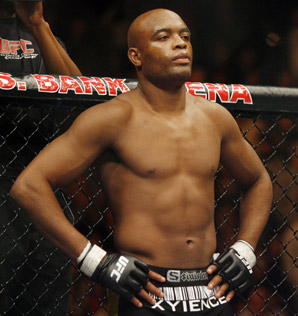
Anderson Silva proves why he’s one of the best fighters in MMA

anderson-silva(This piece appeared in 8CountNews on July 22, 2009)

by Mark Lorenzana

In the last couple of pieces I’ve written about Anderson Silva, I have been highly critical of him mainly because of his last two title defenses against Thales Leites and Patrick Cote. In both fights, Silva had been less-than-stellar, and the fans’ displeasure showed— booing and jeering him in the course of the fights up until the post-fight interview with Joe Rogan. However, I must admit now that I had miscalculated immensely on my criticisms. Silva’s last performance left me eating a lot of crow with a generous helping of humble pie on the side.

Why?

Well, Silva toying with his last two opponents was not so much to assert his superiority and to embarrass them as to show his frustration and make a point that they didn’t want to engage with him. To put it simply, it wasn’t entirely his fault. It takes two to tango. Styles make fights. In Silva’s last couple of fights before facing former UFC Light Heavyweight Champion Forrest Griffin, the Spider did not have a willing dance partner. Both guys didn’t fight to win, they fought to survive, and nobody can really blame them. To last the distance against one of Mixed Martial Arts’ pound-for-pound best is a huge achievement in itself.

At UFC 101: Declaration last Saturday, August 8 at the Wachovia Center in Philadelphia Pennsylvania, Griffin proved to be a more than willing dance partner and he paid dearly for it. He opted to slug it out with Silva, and it certainly didn’t help that his mode of attack involved holding his chin up high instead of tucking it in while throwing arm punches that were as slow as molasses.

Silva shrugged off the few punches that landed for Griffin while deftly avoiding most of the fists that flew around him, hitting nothing but air. Then Silva struck, and Griffin got knocked down. Griffin gamely stood back up on his feet and tried to retaliate only to absorb another punch on the chin and suffer another knockdown. The end came with Griffin wildly and rather amateurishly swinging at Silva, and the latter, while backing up, unleashed a short, popping right jab that caught Griffin flush. Griffin dropped so hard to the mat that the referee did not even bother to administer the count and immediately waved him off.

A couple of things immediately came to my mind after the brutal and humiliating knockout. One, Griffin was the naturally bigger guy and Silva annihilated him. Silva’s lanky and wiry frame is more suited to 185 pounds and the weight gain was evident in that one could obviously see the reigning UFC Middleweight Champion sporting a visible paunch where rock-hard, six-pack abs should have been. Even so, none of this mattered anyway because of the ease with which Silva dispatched the always dangerous Griffin.

Two, Silva has practically cleaned out the 185-pound division and it’s a bit scary to consider that he could possibly clean out the light heavyweight division as well despite being a natural middleweight and having just a couple of fights at 205 pounds under his belt. Two fights, by the way, that both ended in stoppage victories. And can you imagine a super fight that would involve Silva and fellow Brazilian Lyoto Machida? I hope UFC President Dana White holds true to his word and make the fight happen, regardless of the fact that both Silva and Machida vowed never to square off against each other inside the Octagon.

One last note on the Silva – Griffin fight: Personally, I’m not buying the rumors circulating that the fight was fixed. What would Griffin gain by throwing the fight away? The simple explanation would be that Silva had just too much talent, too much skill, and too much firepower for Griffin to handle. Perhaps the embarrassment and humiliation of the brutal knockout was also too much for Griffin to handle, as he immediately stormed off the Octagon – without even bothering to get interviewed by Rogan – towards the locker rooms with his entourage in tow.

After Silva’s performance, the fans at the Wachovia Center did not dare boo him during the post-fight interview. They simply weren’t in the position to do so. Everyone witnessed one of the all time greats ply his trade with a combination of brutal ferocity, expert skill, and fine-spun finesse. Right now Silva is in a class by himself. It was just one of those nights where Silva once again proved why he is currently one of the best fighters in MMA.

Penn’s reign

I always thought that BJ Penn bit off more than he could chew by moving up and challenging reigning UFC Welterweight Champion Georges St-Pierre. As superbly talented and gifted a fighter as Penn is, St-Pierre’s combination of raw strength, power, and unparalleled conditioning is just a bad match up for the Prodigy and it showed in the two fights that they figured in, the first bout being a closer one notwithstanding.

Down at lightweight, though, it’s a totally different story. At 155, the Prodigy is at the top of the food chain, the unrivaled predator. And the co-main event between Penn and Kenny Florian proved just that. Props to Florian, a great competitor and worthy adversary, for trying his best to grab the belt from Penn, but he was just overwhelmed by the pure fighting skills of the Hawaiian. At first I thought that Florian’s approach of trying to clinch with Penn and subsequent attempts to take him down was a good strategy, perhaps because Florian believed that he was at a disadvantage on the stand up. However, I was dead wrong as Florian couldn’t successfully take down Penn. On the contrary, the lone successful takedown in the fight was done by Penn, which eventually led to a submission victory via rear-naked choke at 3:54 of the fourth round as the reigning UFC Lightweight Champion retained his belt.

With that said, I honestly don’t see anyone at the lightweight ranks right now that could take Penn’s belt away from him. His last loss at the 155 weight division was seven years ago against Jens Pulver at UFC 35: Throwdown, which he later avenged at the Ultimate Fighter 5 Finale by submitting Pulver.

Penn, like Silva, is at the top of his game right now. It’s going to be a long reign for one of the most naturally-gifted warriors MMA has ever seen.

Kimbo Slice and The Ultimate Fighter: A Chance at Redemption

(This piece appeared in 8CountNews on June 13, 2009)

by Mark Lorenzana

A few months ago I wrote an article about Kimbo Slice and his fall from the MMA world following a disappointing loss to unheralded last-minute replacement Seth Petruzelli. In the article, I speculated on Slice’s future following his loss and the subsequent bankruptcy of Elite XC: “It remains to be seen whether Kimbo Slice can pick up the pieces of his MMA career, a career that was prematurely cut short by a last-second replacement that he outweighed by 30 pounds. It remains to be seen whether another promotional MMA outfit will express interest in him and pick him up. Perhaps the Kimbo Slice and Elite XC debacle should be a lesson to everyone in the MMA scene.”

It appears that I spoke too soon. It seems that Slice is slated to join the forthcoming season of “The Ultimate Fighter,” the Ultimate Fighting Championship’s reality TV series. “The Ultimate Fighter: Heavyweights” will feature Rashad Evans and Quinton Jackson as the opposing coaches.

What makes this recent development doubly interesting is that when Slice was still fighting for Elite XC as its poster boy, Dana White had been dishing out some pretty nasty comments directed at the former street fighter.

“Sean Gannon beat him in a street fight,” said White in a previous interview. “Everyone saw what happened to Sean Gannon when he fought a guy that no one ever heard of (a decisive TKO loss to Branden Lee Hinkle in the UFC). Gannon was in the hospital for three weeks. That’s what would happen to Kimbo Slice if he fought in the UFC. He would get hurt bad – real bad.”

White then added that the only way Slice could fight in the UFC was if he joined and competed in “The Ultimate Fighter”.

Well, Slice didn’t waste any time and has called White’s bluff.

So to paraphrase White, will Slice get hurt bad – real bad, when he finally locks horns with the other Ultimate Fighter contestants?

It’s hard to speculate, and only time will tell. It’s safe to say, however, that the fighters that will be joining the tenth installment of “The Ultimate Fighter” will not be the same come forward brawlers that Slice destroyed in his Internet videos. Those guys would have had several fights under their belts already and would have already competed in several MMA events.

Take for example just a few of the participants of “The Ultimate Fighter 10”, Roy Nelson, Marcus Jones, Wes Sims, and Justin Wren.

– Nicknamed “Big Country”, Roy Nelson sports a 13-4-0 win, lose, draw record. He competed in the heavyweight division of the now defunct International Fight League where he was its last heavyweight champion. Nelson fought against the likes of Andrei Arlovski (at Elite XC Heat) where he was knocked out in the second round. His recent fight was part of Roy Jones Jr.’s hybrid boxing/MMA card “March Badness” on March 21st. He was defeated by ADCC Champion Jeff Monson by unanimous decision.

– A former NFL defensive tackle, Marcus Jones played college football for the University of North Carolina and has played six years of professional football for the Tampa Bay Buccaneers. Jones made his professional MMA debut on October 26, 2007, in World Fighting Championships 5 with a victory over Will Mora. He trains at Gracie Tampa with instructor Rob Kahn. Jones sports a 4-1-0 fight record.

– Towering at 6’10”, Wes Sims is one of the tallest MMA fighters today. He has fought (and lost) three times in the UFC, two times going against Frank Mir and one time against Mike Kyle. His fight record stands at 20-11-1 with two no contests.

– Justin “The Viking” Wren has been competing at local MMA events and won his first three fights by knockout before taking his first and only loss to date. Wren then won three more fights and his current record stands at 6-1-0.

Indeed, Slice will have his work cut out for him. During his short stint at Elite XC, he was pitted against brawlers and fighters past their primes such as a shot Ray Mercer and an aging Tank Abbott. To reiterate my point, he will not have the same superstar status that he once enjoyed. He will have to go back to square one and start afresh.

Sometimes the best way to the top is not to go through shortcuts. Oftentimes, the long, grueling road builds more character, and eventually brings those who hunger for it, redemption.