Fight Scribe Bullets: (Very) Late Afterthoughts on UFC 144

(This piece appeared in my now defunct fight blog, Pinoy Fight Scribe, in 2012.)

by Mark Lorenzana

I haven’t written any MMA posts for some time now, so let’s have a UFC 144 bullets post. After all, this blog isn’t called Pinoy Boxing Scribe, but Pinoy Fight Scribe. But I guess you’ve already figured that out by now. Duh. Anyway, on to the bullets:

– I posted this the other day in my Facebook account:

Funny how Joe Rogan and Mike Goldberg were being a bit biased toward Yushin Okami for the first couple of rounds, and then Tim Boetsch knocks Okami out in the third round. Just because the fight is being staged in Japan doesn’t mean you need to kiss the Japanese fighter’s ass, dudes. Knockout of the night!

OK, now that  I watched the replay, I take back what I said about Rogan and Goldberg being a bit biased toward Okami (yes, most of the time I post stupid stuff on Facebook). I mean, both Rogan and Goldberg can and have been biased in their commentating in the past, but this wasn’t one of those fights. They were calling the fight as it unfolded, and they were correct that Okami had been dominating Boetsch in the first couple of rounds. Until Boetsch connected on some wild but vicious shots on Okami’s mug in round three, that is. I mean, anyone who gets hit flush by Boetsch’s power shots will drop like a sack of potatoes, so the outcome wasn’t really surprising.

Too bad for Okami, though, who got knocked out in front of his countrymen. He could have just hopped on his bike in the third round, considering that he already had the fight in the bag by winning the first couple of rounds handily. In boxing, MMA, and other fight sports that involve striking, power is the great equalizer, and Okami should have realized that. Doesn’t matter if you’re dominating the fight in the scorecards because one punch or kick can change everything.

Oh, and yes, Boetsch didn’t get “knockout of the night” honors. Anthony Pettis did.

– In mixed martial arts, you can’t be a one- or two-trick pony. MMA is one of the fastest-evolving sports, and fighters need to be well versed in striking, grappling, and wrestling to be able to reach the highest levels. Chuck Liddell relied more and more on his right hand (as well as his take-down defense but nothing else) in the latter stages of his career, and he paid the price for it. Same goes for Tito Ortiz who is arguably the best ground-and-pound fighter in history but who possesses no more than a working man’s ability on the stand-up and, not to mention, Royce Gracie who is one of the best ground fighters in the game but has not been able to improve on the other aspects, notably in both striking and wrestling, to be able to compete at a high level with more versatile opponents. These guys are specialists, and what I mean by specialists is that they are  more well-versed in certain aspects of the game rather than being all-around fighters.

Jake Shields is one of the best specialists in the game today. He has a great wrestling and jiu-jitsu background—he is a former NCAA Division II wrestler and has a black belt in Brazilian jiu-jitsu under Cesar Gracie. His weakness, though, is his striking. He doesn’t have much pop in his shots that’s why he always looks to bring the fight to the ground. In his fight with Yoshihiro Akiyama, it was apparent that Shields had a disadvantage in the striking department against  the Japanese brawler and judo master but, surprisingly, decided to fight toe-to-toe with Akiyama for most of the fight. In fact, Shields won a wide unanimous decision mostly because of his striking. I saw an improved stand-up game from Shields, and if he continues to work on his punches and kicks enough to get more power behind those shots, he might just find himself in prime position for a crack at the UFC welterweight title again.

– Cheick Kongo and Mark Hunt aren’t the best MMA heavyweights out there, but I always get a kick (pun not intended) whenever two huge guys fight each other. You just can’t afford to blink, or else you’re gonna miss a devastating and exciting knockout. I’m glad I didn’t blink because the fight was over at around the two-minute mark of the first round. Hunt has heavy hands, and Kongo should have been more wary of the Super Samoan’s fists. Instead, Kongo left his mug open and got cracked by several nasty punches. That’s all it took to plaster Kongo on the canvas. Don’t count on any of these guys to be fighting for the UFC heavyweight title soon, though.

– Quinton “Rampage” Jackson came in six pounds over the light heavyweight limit of 205 against Ryan Bader and, as a result, had to give up 20 percent of his purse. The extra weight didn’t help Jackson, though, because Bader cruised to a unanimous decision victory. Jackson looked like he was out of shape, and there are reports that he was fighting with a hurt hand. There are also some talks that Jackson took Bader lightly. That shouldn’t take anything away from Bader, though, who did what he needed to do to secure the win.  Bader has improved his game a lot, especially his defense, but it’s safe to say that he’s still a long way from a rematch against Jon “Bones” Jones who virtually destroyed him in their first fight.

– Pitbulls were originally bred to fight each other, and dogfighters measure a dog’s worth by its gameness. Gameness is a term that often refers to the eagerness of a dog to accomplish its task despite the threat of substantive injury. A game working dog will keep on working until it accomplishes its task, and a game pitbull will fight on for hours and will shrug off blood loss, dehydration, exhaustion, and even broken bones until it kills the other dog or until it dies, whichever comes first. One journalist put it best when he wrote, “Game is the dog that won’t quit fighting, the dog that’ll die in the ring, the dog that’ll fight with two broken legs.”

In the MMA world, one of the gamest fighters out there is Frankie Edgar. You knock him down, you hurt him, you break his nose—he’ll keep coming. Edgar beat B. J. Penn and Gray Maynard (both of them twice!) because he just wouldn’t quit. Edgar almost beat Ben Henderson (who put in a very good performance but was a little tentative at times, which accounted for some of the fight’s lulls in action) because he just wouldn’t quit. Edgar is a small lightweight, and his walking weight is probably just a couple of pounds over the 155 limit, but he makes up for the size disadvantage  with his speed and tenacity. I’m not a big fan of Edgar, but I’ve got tons of respect for the guy just like, I’m sure, many MMA fans out there. Edgar and Henderson both won “Fight of the Night” honors, and I hope they fight again soon. Edgar might have lost his title, but he shouldn’t be ashamed of his performance. If he decides to go down to featherweight or even down to bantamweight, he might even become a dominant force.

With Edgar’s gameness, I wouldn’t doubt that at all.
Pacquiao’s win over Marquez raises more questions than answers

(This piece appeared in InterAKTV in 2011.)

by Mark Lorenzana

“I clearly won the fight.”

It’s hard to tell if Manny Pacquiao said that with real conviction during the postfight interview after another grueling fight with Juan Manuel Marquez. After 36 brutal rounds, the only clear thing is that Pacquiao seems to have found the perfect foil in Marquez. “Marquez has Manny’s number,” Pacquiao trainer Freddie Roach said after the third fight. Not a lot of people will disagree with that assesment.

The trilogy has, so far, yielded one draw and two wins for Pacquiao. The third bout was supposed to be the most decisive of all three battles, but the outcome only managed to raise more questions than answers.

Did Juan Manuel Marquez hurt Pacquiao?

Does Juan Manuel Marquez, someone who has fought at the welterweight limit only a couple of times in his career, punch harder than full-fledged welterweights like Antonio Margarito and Miguel Cotto?

When Pacquiao fought Margarito and Cotto, he took both those guys’ best shots, even egging them on to punch him in the body so that he could taste their power. This drew the consternation of Freddie Roach, but it was all good because Pacquiao never really buckled under the onslaught. The Pacquiao against Cotto and Margarito was far more accurate than the one against Marquez because Manny seemed more confident and at ease when he fought those two bigger guys; he let his hands go freely and wasn’t afraid to engage.

Against Marquez, Pacquiao seemed nervous and tentative, he missed a lot, and most of his punches were short and didn’t connect because he wasn’t close enough to hit his target; Pacquiao seemed afraid to engage. Again, does Juan Manuel Marquez punch harder than naturally bigger men like Margarito and Cotto?

What was Pacquiao’s game plan going into the fight?

Freddie Roach said part of the strategy was to avoid Marquez’s right hand. “Manny’s a left-hander and if you’re fighting a right-hander like Marquez, you don’t slide to his right because he’s going to hit you every time,” said Roach. But Pacquiao repeatedly slid right directly into Marquez’s straight hand, and naturally, he got hit every time.

Another plan, according to Roach, was to go to the body early, something that could have slowed the 38-year-old Marquez down. But Pacquiao went to the body sporadically and essentially headhunted most of the fight, with little success.

For some strange reason, Pacquiao deviated from the game plan. Did he do it on purpose, or were there other factors that kept him from doing what he needed to do to win the fight in more convincing fashion?

Did Pacquiao overthink Marquez?

Former heavyweight champion George Foreman, who also worked briefly as a boxing analyst for HBO, always said during broadcasts that a fighter shouldn’t overanalyze his opponent’s style. His advice? Just fight.

In the first two bouts against Marquez, that was what Pacquiao did—he just fought. And because of that he was able to knock down Marquez four times. In those instances, Pacquiao just let his hands go and peppered the Mexican with punches from weird angles. Marquez didn’t know where the punches were coming from, so he eventually got hit with solid shots and went down several times.

Also, Pacquiao has a wider repertoire of punches now, so why didn’t he throw more hooks and uppercuts instead of just throwing spartan 1-2 combinations all night? Before the fight, Evander Holyfield said that all Pacquiao needs to do to win is to be himself. Against Juan Manuel Marquez, does Pacquiao find it hard to be his explosive, unpredictable self?

After three close fights where Pacquiao was very, very lucky to escape with a draw and a couple of close wins, it certainly seems to appear that way.

What should Marquez do for him to win against Pacquiao?

The first couple of fights were very close and could have gone either way, but in the third one Marquez looked to be more in control and landed the more telling blows.

f course the Pacquiao aggression was there as usual, but it was not effective aggression. Against David Diaz, Oscar De La Hoya, Ricky Hatton, Miguel Cotto, Antonio Margarito, Joshua Clottey, and Sugar Shane Mosley, Pacquiao showed effective aggression; in this fight he seemed lost and out of sync. Perhaps this was the reason why, as Time Magazine’s Gary Andrew Poole said, “No one on press row had Pacquiao winning, and only a few had him stealing a draw.”

Marquez’s “problem” (if we can call it a problem) is that he is a counterpuncher, and a lot have argued that this is precisely why he can’t win in the eyes of the judges—in close fights, judges tend to favor (fairly or unfairly, you be the judge) the more aggressive fighter even if the more defensive fighter lands the cleaner shots. What’s ironic in this case is that it’s precisely this counterpunching style that has made Marquez very difficult to solve for Pacquiao.

Needless to say, if Marquez employed a more aggressive style against the Filipino, he would be playing right into Pacquiao’s hands and would be deposited in the canvas in no time. In this case, Marquez finds himself in a quandary: fight smart and lose in the eyes of the judges or fight aggressively and get knocked out.

It’s a no-win situation for him, and you can’t help but feel sorry for the guy and all the hard work he always puts in. This is a painful case of “damned if you do, damned if you don’t” for Juan Manuel Marquez.

Is Pacquiao slowing down?

Was Pacquiao’s less-than-stellar performance a sign that he is finally slowing down and that his skills are eroding, or is it just purely because of Marquez’s style, a style that has given Pacquiao fits for three fights now? Pacquiao has supposedly suffered cramps again, which may be a sign that his body is not what it used to be. At 32, Pacquiao is not exactly a spring chicken, and there are a lot of fighters (especially offensive pressure fighters) who have appeared to age overnight. The next fight against another opponent (preferably one who will take the fight to Pacquiao) will, hopefully, answer that question.

Will there be a fourth fight?

Yes, perhaps. That is, if Pacquiao is still up to it.

JULIO CESAR CHAVEZ JR.: THE LEGEND THAT SHOULDN’T BE

Chavez(This piece appeared in FightHype on June 30, 2010)

by Mark Lorenzana

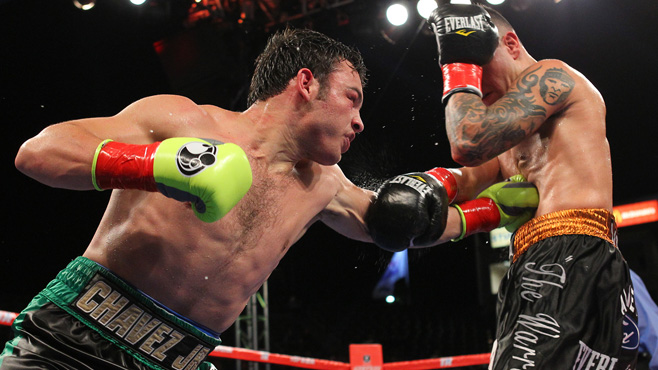
Julio Cesar Chavez Jr., like his father once was, is a boxer. At the young age of 24, Chavez Jr. has already fought a total of 43 fights. He has an impressive ring record of 41 wins, 30 knockouts, zero losses with one draw and one no contest. He has had little amateur background; he fought a total of three amateur fights before deciding to turn pro in September 26, 2003 at age 17. Chavez Jr. won his professional debut, which was fought at super featherweight, by decision against one Jonathan Hernandez.

In 2004, Chavez Jr. fought 11 times, fighting at least once a month except in August of that year. He won all 11 fights, knocking out eight of his opponents and out pointing three. In 2005, his 19-fight winning streak came to a halt when he salvaged a draw against fellow countryman Carlos Molina. After that fight, he once again racked up 17 straight wins before a win over American Troy Rowland was downgraded to a no contest.

Despite his stellar and unblemished record so far, there is no dearth of critics who seem hell bent on making life miserable for the younger Chavez. Some say his impressive record has been padded, that he has been fed a steady supply of club fighters in the course of his career, that he is a spoiled fighter. In his first fight against Matt Vanda, Chavez barely held on for a split decision win to keep his unbeaten record intact. Not a few pundits believed that he won a gift decision. His father, Chavez Sr., insists that his son fought sick in that particular fight and must be given the benefit of the doubt. “I don’t like excuses,” Chavez Sr. said, talking to TV Azteca in a post-fight interview. “But my son made a super-human effort, he fought sick and wanted to cancel the fight. The doctor gave him a shot because he had a fever after the weigh-in.”

Chavez Jr., for his part, didn’t blame any illness for his poor showing. “The people wanted me to score a knockout, but I could not,” Chavez Jr. said after the fight. “The people are very, very discontented with the result, and what can I tell you? What can I tell you as a fighter? Everything is just very sad. Because of the fight, I don’t know what to do. I don’t know what I will do. I need to think about it real hard. I am considering retirement.”

Chavez Jr. did not retire and instead fought Vanda in a rematch, a fight that the former won, and won convincingly. Yet in the run up to the fight against Irish middleweight contender John Duddy several days ago, a lot of experts predicted Chavez Jr. to lose by knockout. A rejuvenated Chavez Jr., with four-time trainer of the year Freddie Roach at the helm, beat Duddy via unanimous decision to earn the vacant WBC Silver middleweight title. In that fight, Chavez Jr. did not gas out in the championship rounds and showed remarkable poise and a huge heart against the dangerous and courageous Duddy.

Despite the hard-fought win, don’t expect the critics to lay off of the younger Chavez.

Chavez Jr.’s greatest challenge does not in fact come in the form of a gloved warrior like himself, standing in the corner of the ring opposite him. His greatest challenge, quite ironically, is trying to deal with the lofty but somewhat unrealistic expectations of people who see in him the second coming of his father.

“La leyenda continua,” the ring announcer blurts out every time Chavez Jr. is introduced in a fight. “The legend continues.”

Julio Cesar Chavez Sr. is in fact, a legend. He retired at age 43 holding a ring record of 107 wins with 86 knockouts, six losses, and two draws. He is one of the greatest fighters of all time. He has won six world titles in three weight divisions: WBC Super Featherweight (1984), WBA Lightweight (1987), WBC Lightweight (1988), WBC Super Lightweight (1989), IBF Light Welterweight (1990), and WBC Super Lightweight (1994). Chavez Sr. also won the Ring Lightweight title in 1988. A list of world champions that Chavez Sr. defeated include Jose Luis Ramírez, Rafael Limón, Rocky Lockridge, Meldrick Taylor, Roger Mayweather, Lonnie Smith, Sammy Fuentes, Héctor “Macho” Camacho, Juan Laporte, Edwin Rosario, Greg Haugen, Tony López, Giovanni Parisi, Joey Gamache, and Frankie Randall.

Chavez Sr. also holds records for most title fights (37), most successful consecutive defenses of most title-fight victories (31), most world titles (27) and most title defenses won by knockout (21). He also holds the longest undefeated streak in boxing history, which is 13 years. The Ring Magazine ranks Chavez Sr. as the 18th greatest fighter of the last 80 years. He was also ranked #50 on Ring Magazine’s list of “100 greatest punchers of all time”. He ranks #24 on ESPN’s 50 Greatest Boxers Of All Time.

Julio Cesar Chavez Jr., like his father once was, is a boxer. And the comparisons, to be fair for both father and son, should end right there.

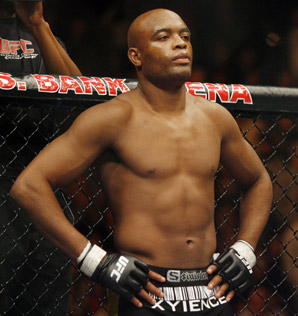
Anderson Silva proves why he’s one of the best fighters in MMA

anderson-silva(This piece appeared in 8CountNews on July 22, 2009)

by Mark Lorenzana

In the last couple of pieces I’ve written about Anderson Silva, I have been highly critical of him mainly because of his last two title defenses against Thales Leites and Patrick Cote. In both fights, Silva had been less-than-stellar, and the fans’ displeasure showed— booing and jeering him in the course of the fights up until the post-fight interview with Joe Rogan. However, I must admit now that I had miscalculated immensely on my criticisms. Silva’s last performance left me eating a lot of crow with a generous helping of humble pie on the side.

Why?

Well, Silva toying with his last two opponents was not so much to assert his superiority and to embarrass them as to show his frustration and make a point that they didn’t want to engage with him. To put it simply, it wasn’t entirely his fault. It takes two to tango. Styles make fights. In Silva’s last couple of fights before facing former UFC Light Heavyweight Champion Forrest Griffin, the Spider did not have a willing dance partner. Both guys didn’t fight to win, they fought to survive, and nobody can really blame them. To last the distance against one of Mixed Martial Arts’ pound-for-pound best is a huge achievement in itself.

At UFC 101: Declaration last Saturday, August 8 at the Wachovia Center in Philadelphia Pennsylvania, Griffin proved to be a more than willing dance partner and he paid dearly for it. He opted to slug it out with Silva, and it certainly didn’t help that his mode of attack involved holding his chin up high instead of tucking it in while throwing arm punches that were as slow as molasses.

Silva shrugged off the few punches that landed for Griffin while deftly avoiding most of the fists that flew around him, hitting nothing but air. Then Silva struck, and Griffin got knocked down. Griffin gamely stood back up on his feet and tried to retaliate only to absorb another punch on the chin and suffer another knockdown. The end came with Griffin wildly and rather amateurishly swinging at Silva, and the latter, while backing up, unleashed a short, popping right jab that caught Griffin flush. Griffin dropped so hard to the mat that the referee did not even bother to administer the count and immediately waved him off.

A couple of things immediately came to my mind after the brutal and humiliating knockout. One, Griffin was the naturally bigger guy and Silva annihilated him. Silva’s lanky and wiry frame is more suited to 185 pounds and the weight gain was evident in that one could obviously see the reigning UFC Middleweight Champion sporting a visible paunch where rock-hard, six-pack abs should have been. Even so, none of this mattered anyway because of the ease with which Silva dispatched the always dangerous Griffin.

Two, Silva has practically cleaned out the 185-pound division and it’s a bit scary to consider that he could possibly clean out the light heavyweight division as well despite being a natural middleweight and having just a couple of fights at 205 pounds under his belt. Two fights, by the way, that both ended in stoppage victories. And can you imagine a super fight that would involve Silva and fellow Brazilian Lyoto Machida? I hope UFC President Dana White holds true to his word and make the fight happen, regardless of the fact that both Silva and Machida vowed never to square off against each other inside the Octagon.

One last note on the Silva – Griffin fight: Personally, I’m not buying the rumors circulating that the fight was fixed. What would Griffin gain by throwing the fight away? The simple explanation would be that Silva had just too much talent, too much skill, and too much firepower for Griffin to handle. Perhaps the embarrassment and humiliation of the brutal knockout was also too much for Griffin to handle, as he immediately stormed off the Octagon – without even bothering to get interviewed by Rogan – towards the locker rooms with his entourage in tow.

After Silva’s performance, the fans at the Wachovia Center did not dare boo him during the post-fight interview. They simply weren’t in the position to do so. Everyone witnessed one of the all time greats ply his trade with a combination of brutal ferocity, expert skill, and fine-spun finesse. Right now Silva is in a class by himself. It was just one of those nights where Silva once again proved why he is currently one of the best fighters in MMA.

Penn’s reign

I always thought that BJ Penn bit off more than he could chew by moving up and challenging reigning UFC Welterweight Champion Georges St-Pierre. As superbly talented and gifted a fighter as Penn is, St-Pierre’s combination of raw strength, power, and unparalleled conditioning is just a bad match up for the Prodigy and it showed in the two fights that they figured in, the first bout being a closer one notwithstanding.

Down at lightweight, though, it’s a totally different story. At 155, the Prodigy is at the top of the food chain, the unrivaled predator. And the co-main event between Penn and Kenny Florian proved just that. Props to Florian, a great competitor and worthy adversary, for trying his best to grab the belt from Penn, but he was just overwhelmed by the pure fighting skills of the Hawaiian. At first I thought that Florian’s approach of trying to clinch with Penn and subsequent attempts to take him down was a good strategy, perhaps because Florian believed that he was at a disadvantage on the stand up. However, I was dead wrong as Florian couldn’t successfully take down Penn. On the contrary, the lone successful takedown in the fight was done by Penn, which eventually led to a submission victory via rear-naked choke at 3:54 of the fourth round as the reigning UFC Lightweight Champion retained his belt.

With that said, I honestly don’t see anyone at the lightweight ranks right now that could take Penn’s belt away from him. His last loss at the 155 weight division was seven years ago against Jens Pulver at UFC 35: Throwdown, which he later avenged at the Ultimate Fighter 5 Finale by submitting Pulver.

Penn, like Silva, is at the top of his game right now. It’s going to be a long reign for one of the most naturally-gifted warriors MMA has ever seen.

Floyd is an “exciting” talker, but needs to be a more exciting fighter

Floyd_Baldomir(This piece appeared in 8CountNews on July 22, 2009)

by Mark Lorenzana

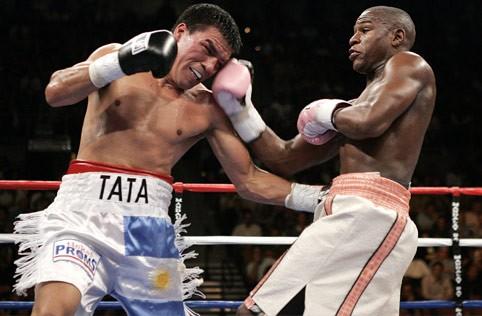
Floyd Mayweather Jr. is known for his tactical, defensive style when he fights. He might not be a crowd pleaser in the mold of the late Arturo Gatti or current pound-for-pound king Manny Pacquiao, but you have to give credit where credit is due. The guy is one of the true master practitioners of the Sweet Science.

However, in contrast to his subdued and safety-first attitude inside the ring is his brash, offensive, and loud nature outside of it. Mayweather. is most especially adept at trash talking, and one would be hard put to distinguish between pure theatrics for the purposes of fight promotion and real insulting behavior.

Take Mayweather ‘s latest comment for instance, from a recent Cagewriter report: “In boxing, we know who’s dominating. Black fighters and Hispanic fighters is dominating in this sport. And this is not a racial statement but there’s no white fighters in boxing that’s dominating, so they had to go to something else and start something new.”

Let’s take a look at the current champions in several weight divisions to see if there is any truth to Mayweather’s claim.

In the heavweight division, Ruslan Chagaev and Nikolay Valuev currently share the WBA heavyweight title. Wladimir Klitschko currently holds the IBF, WBO, IBO and Ring Magazine world heavyweight titles. His elder brother, Vitali Klitschko, is the current WBC world heavyweight champion. All four are white. Going down to cruiserweight, we have a couple of white fighters, Tomasz Adamek, the IBF titleholder, as well as Giacobbe Fragomeni, the WBC champion. Over at super middleweight, we have a trio of white boxers, namely WBA super middleweight champion Mikkel Kessler, WBC super middleweight titlist Carl Froch, and IBF super middleweight titleholder Lucian Bute. Felix Sturm and Kelly Pavlik, both white, hold most of the alphabet belts at middleweight. Vyacheslav Senchenko is the current WBA welterweight champion. And, you guessed it, he is white as well.

I’d like to go on and on but I guess I’ve already made my point. Those are already 12 Caucasian boxing champions that I mentioned. So, needless to say, Mayweather’s latest comment about black guys “dominating” boxing is really baseless. Remember, this is the same guy who criticized HBO and their broadcast team in an interview with Grand Rapids Press’ David Mayo last year.

“Even a guy like Jim Lampley, he praises Kelly Pavlik — who has won some good fights, he beat Jermain Taylor twice, we have to give him credit for that — but they talk about Kelly Pavlik, a white fighter, like he’s the second coming or they go crazy over Manny Pacquiao. But I’m a black fighter,” Mayweather. said.

“Is it racial? Absolutely. They praise white fighters, they praise Hispanic fighters, whatever. But black fighters, they never praise. I’ve noticed it for a long time but I couldn’t say anything because I had to do business with them. I’ll still do business with them, but I’m done holding my tongue.”

The HBO team did not praise Pavlik because he is white. They commended him for his fan-friendly fighting style. The HBO people go gaga over Pacquiao not because he is Filipino, but because he fights like there’s no tomorrow. HBO aired an Arturo Gatti tribute not because he was white, and fight fans mourn Gatti’s loss because he was the consummate blood and guts warrior, because of his fights with Micky Ward, and because he ignored pain and physical injury, leaving everything in the ring.

Truth is, maybe Mayweather is just unpopular with boxing fans, especially the casual boxing fans, because he isn’t that exciting to watch.

Ouch.

The truth hurts, but hey, it’s the truth. Mayweather can’t fault the fans if they don’t find him exciting enough. So, as you see, this is not an issue of race at all.

I cover both the MMA and boxing beat for this website and I don’t see a problem at all with both sports coexisting. The last thing we need is negative comments that could fuel hatred and bigotry.

One of my favorite fighters in MMA today is Anderson “The Spider” Silva. He is black. But I wouldn’t have cared any less if he were of another skin color. I really don’t care. I like Silva and respect him irrespective of his race. I follow his fights because I enjoy watching them.

I wish I could say the same thing for Mayweather. I wish I could say that I really enjoy watching his fights.

But then I remember his fight against Carlos Baldomir where a lot of fans left the stadium out of boredom long before the final bell rang.

I hope Mayweather does something soon, before it’s too late. I’m sure he wants to be remembered more as an exciting fighter rather than an “exciting” (with emphasis on the quotation marks) talker.