On the Mark: Bivol Brings Canelo Back Down to Earth

(Note: This originally came out on May 9, 2022, in PNM.)

by Mark Lorenzana

The last time I saw Saúl “Canelo” Álvarez really hurt and in serious trouble inside the boxing ring was against José Miguel Cotto, the older and less-accomplished brother of multiple-time world champion and recent International Boxing Hall of Fame inductee Miguel Angel Cotto.

In that fight, the shorter Cotto stormed out of the gate swinging, determined to hunt down Álvarez and take the fight to him. But Canelo, who opted to play the calculating matador to the aggressive and onrushing Puerto Rican bull, was having success early on at taming Cotto’s rushes. After all, Álvarez was younger, taller and rangier, and this left Cotto mostly punching air and hitting Canelo’s gloves.

Until the 1:26 mark of the opening round, that is.

Álvarez threw a left straight, right cross and left uppercut combo that mostly missed and then backed up near the corner to try to stymie another Cotto assault, when the Puerto Rican connected flush with a short left hook to the Mexican’s uncovered face. This immediately wobbled Álvarez, who bounced against the ropes and continued to absorb punches from the emboldened Cotto. Álvarez staggered around the ring for the remainder of the first round, obviously hurt, with Cotto in hot pursuit, but failing to capitalize and, ultimately, let Canelo off the hook.

This proved to be Cotto’s undoing as Canelo found his range and capitalized on his height and reach to win the fight by technical knockout in the ninth round.

That fight was for the lightly regarded North American Boxing Federation (NABF) Welterweight Championship.

What’s amazing, at least to me, was that it happened in 2010, when Álvarez was just two months shy of his twentieth birthday.

That was — as far as I remember, and I may be wrong — the last time I saw Saúl “Canelo” Álvarez really hurt and in serious trouble inside the boxing ring.

What makes this feat even more incredible is the fact that Álvarez, thereafter, eventually proceeded to go up in weight multiple times to face harder punchers and better boxers than — and no offense to him — José Miguel Cotto: Carlos Baldomir, Alfredo Angulo, Erislandy Lara, Kermit Cintron, Shane Mosley, Floyd Mayweather Jr., the younger Cotto, Gennady Golovkin (twice) and Sergey Kovalev. That ledger is impressive; that list includes current, former and future boxing hall of famers and perpetual contenders.

After that hard-earned fight with José Miguel Cotto, Canelo went on a tear: winning 25 fights, drawing one (against Golovkin) and dropping another (a decision loss to Mayweather, one of the all-time greats, a loss that something any fighter worth his salt would be loathe to be ashamed about). In that span, Álvarez picked up titles at middleweight, super middleweight and light heavyweight, along with a second junior middleweight title reign after losing to Mayweather.

Indeed, before the fight with Dmitry Bivol for the Russian champion’s World Boxing Association (WBO) light heavyweight belt last Saturday night, May 7, Canelo Álvarez has looked virtually unbeatable.

That air of invincibility, however, would come crashing down.

Coming into the fight, oddsmakers had installed Álvarez as the five-to-one favorite over Bivol, but the Russian had other things in mind.

(An aside: Bivol might have been the underdog, but he was still the bigger man; after all, it was Canelo who was coming up in weight to challenge him. In other words, the Russian was a live underdog in that fight. Not as big of a long shot compared to Kentucky Derby winner Rich Strike, the horse that won a stunning upset — also last Saturday — despite being an 80-1 underdog. Rich Strike wasn’t even in the field until last Friday, May 6, when another colt was scratched from the race, but the thoroughbred came from behind to win America’s greatest horse race, pulling off one of the biggest shocks in Kentucky Derby history. That’s another story, though — or perhaps another column? What can I say? I love rooting for the underdog.)

In the opening round, Canelo started off fast, with guns blazing. He stalked Bivol and was the aggressor, coming forward and landing power shots both to the head and body of the taller Russian. Álvarez continued his assault in the second and third rounds, and looked to cruise to another comfortable decision victory. But then Bivol started to assert himself.

In the fourth round onward, Bivol began to use his superb boxing skills to frustrate Álvarez; the Russian has good hand speed for his size, and when he started stringing combinations together, the Mexican started to buckle a bit under the onslaught.

“I did feel his power,” Álvarez admitted in a post-fight interview.

In the middle rounds, Álvarez also seemed to run out of steam. His body language was telling: leaning on the ropes and letting Bivol unload on him, throwing nothing in return as the Russian fired off punch after punch, and also dropping his guard for most of the rounds, especially the latter minutes of the rounds — a sign of a gassed fighter trying to catch his breath.

Álvarez tried to rally in the later rounds, but it wasn’t enough. In the end, all three judges scored the fight 115-113 for Bivol.

“No excuses,” Álvarez said. “I think that’s what happens in the sport of boxing — you win or lose. That’s the sport, and that’s what happened. He’s a very good fighter.”

A very good, bigger fighter. There’s an old adage in boxing: A good big man always beats a good little man. At least on that night, this old adage rang true. As much as fighters want to flout weight classes in their quest for greatness — think not only Canelo and Mayweather as the guilty parties, but also Manny Pacquiao and Henry Armstrong — these weight classes exist, after all, for a reason.

Álvarez must have felt what José Miguel Cotto felt those many years ago, but this time with the situation reversed.

“I’m glad I proved myself. I’m the best in my division and I get to keep this belt,” said Bivol. “He’s a great champion, I respect him and all his team.”

The Mexican, however, is looking to bounce back as soon as he can. “Of course I do,” Álvarez answered when asked if he wanted a rematch. “It can’t end like this.”

Saúl “Canelo” Álvarez had been on cloud nine for the past several fights now, owing to his dominance in climbing several weight divisions and leaving bigger opponents bloodied and beaten in his wake. It took a skilled champion, the bigger and equally talented Dmitry Bivol, who was also a five-to-one underdog, to bring the Mexican sensation down to Earth — at least for now.

Valdez Drops WBC Title in Lopsided Bout against Stevenson

(Note: This originally came out on May 2, 2022, in PNM.)

by Mark Lorenzana

“I want to be one of the greatest Mexican fighters of all time.”

This was the confident answer of Óscar Valdez Jr. — a two-time Olympian who represented Mexico in Beijing 2008 and again in London in 2012 — when asked at a pre-fight interview before his scheduled bout against World Boxing Organization (WBO) super featherweight champion Shakur Stevenson what he wanted his legacy to be in boxing. And he certainly looked the part when Valdez met fellow Mexican Miguel “Alacran” Berchelt in the ring on Feb. 20, 2021, to challenge Berchelt for his World Boxing Council (WBC) super featherweight title.

In that fight, Valdez — originally from Nogales in the northern Mexican state of Sonora,but now fighting out of Tucson, Arizona — flattened Berchelt, the odds-on favorite. With a minute and 10 seconds remaining in the ninth round, Valdez landed a hybrid right overhand-uppercut followed by a left hook that dropped Berchelt, who recovered well after the knockdown to keep on fighting.

The end, though, came a round later when an aggressive and desperate Berchelt, trying to score a knockout, lunged and left himself wide open, absorbing a crushing left hook from Valdez that deposited him to the canvas. There would be no recovering for Berchelt, after that devastating shot; Valdez was crowned the WBC super featherweight champion that night.

Valdez, however, wasn’t expected to duplicate that feat against Stevenson, who himself picked up his super featherweight strap in impressive fashion by dominating erstwhile WBO champion Jamel Herring in October of last year en route to a 10th-round technical-knockout victory. Berchelt, like Valdez, has dynamite in his fists, but he doesn’t quite possess the ring savvy of a Stevenson — an Olympian in his own right, who represented the United States at the 2016 Summer Olympics in Río de Janeiro.

On the one hand, Berchelt is a jackhammer who keeps on coming, overwhelming opponents through sheer blunt-force trauma. But Berchelt’s come-forward style can also be his undoing, as evidenced by that well-placed counterpunch that Valdez used to knock Alacran out in their fight. Stevenson fights at his own pace — and forces you to fight at his own pace. Pure pressure fighters — in the mold of the aforementioned Berchelt, as well as, to an extent, Valdez — like to keep their opponents on the defensive end all night long, while fighters like Stevenson with a high ring IQ can adjust to an opponents’ fighting style and make you fight their fight.

Which was exactly what unfolded when Shakur Stevenson finally traded leather with Óscar Valdez Jr. on the night of Saturday, April 30, at the MGM Grand Garden Arena in Las Vegas for their unification bout, with both fighters’ titles on the line, in addition to the Ring Magazine super featherweight belt.

It was evident at the outset who would control the fight. The 31-year-old Valdez came out at the opening bell eager — too eager, perhaps — as the Newark, New Jersey–native Stevenson, seven years younger, made him miss and miss badly. (One of those bad misses caused Valdez to slip and stumble and fall to the canvas in the first round.) While Valdez appeared overeager, sometimes lost, Stevenson controlled the distance with a crisp and effective jab.

It was also evident who the bigger fighter was. At the weigh-in the day before, it didn’t really matter as both fighters — like any other boxer well-versed in the art of making weight — did their darn best to dehydrate to make the 130-pound limit, with Valdez weighing a shade below at 129 pounds and Stevenson just making it. On fight night, however, the five-foot-five-inch Valdez looked every inch like a 130-pound super featherweight soaking wet, while the five-foot-seven-inch Stevenson, completely rehydrated, seemed like he had the frame of a full-fledged welterweight. It didn’t help that Stevenson also had a two-inch reach advantage.

This reach advantage Stevenson utilized to the hilt, as he smartly pumped his jab and confused Valdez all night. The bigger Stevenson also had more pop in his shots, as he repeatedly peppered Valdez with power punches: An accurate straight left, and powerful hooks and uppercuts that the American unleashed while on the inside but also, impressively, while backpedaling whenever the Mexican tried to put on the pressure — which lasted the entire 12 rounds, a testament to Valdez’s stamina. The problem for Valdez: It wasn’t effective aggression.

Stevenson punctuated his power advantage in the sixth round when he sent Valdez sprawling to the canvas with a left uppercut to the head. By the championship rounds, Valdez had a mouse under his left eye, a cut below his right eye, and redness and swelling on his forehead; Stevenson was mostly untouched.

In the end, Valdez simply had no answer for Stevenson. Two of the ringside judges scored it 118-109 in favor of Stevenson, while a third saw it 117-110 for the American.

“He is a tough champion, but I was prepared to beat him,” Stevenson said in an interview after the fight. “This victory means everything to me,” he added. “I told you what I would do, and I did it. Valdez is tough, rugged and has power. But I’m ready for anyone, I want all the belts.”

Valdez, for his part, acknowledged that he was bested by Stevenson, at least on that night.

“He has a very great boxing quality, and today he was the best in the ring,” Valdez said. “He moves very well. He’s a champion. He has speed. He’s a great boxer.”

Valdez also apologized to his countrymen.

“I tried to bring the belts to Mexico. I’m sorry, we tried,” he said.

Let’s be clear: A champion who gave all he could against a younger, taller, bigger, stronger and faster opponent has nothing to be ashamed of, or to apologize for.

But being one of the greatest Mexican fighters of all time?

That, unfortunately, would have to wait.

A Short But Immensely Unpopular Opinion About Jake Paul

by Mark Lorenzana

I’m not a professional boxing writer. Well, I used to be many years ago, but it was a short-lived gig that never earned me enough money to help me quit my day job anyway (but that’s another story altogether), so now I just run this blog where I can post unpopular and stupid opinions freely about fights that interest me.

Speaking of unpopular and stupid opinions, here’s one:

I love what Jake Paul is doing.

A lot of boxing purists say that he’s an embarrassment to the sport.

Well, aren’t those sanctioning bodies that only care about money—more than the welfare of the sport and its fighters—more of an embarrassment? Or those equally greedy boxing promoters who bleed their fighters dry? Or how about the so-called best-of-the-best fighters (mostly self-proclaimed, actually) who only pick and choose who they will meet in the ring?

It’s not hard to see the reason why Jake Paul is immensely hated: he didn’t start out as a boxer; he didn’t cut his teeth on the sweet science. He started out as a social media personality, and a controversial one at that. But I won’t dwell on his status as an influencer; this is a boxing blog after all.

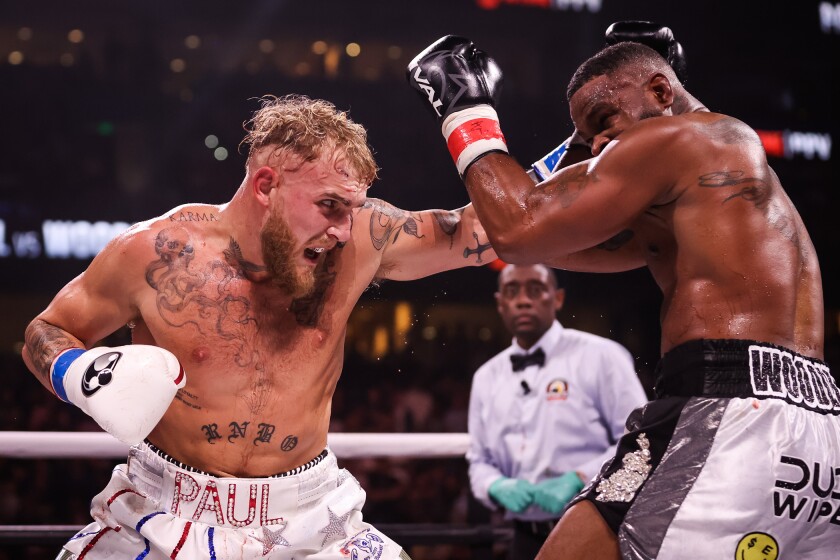
Jake Paul is currently 5-0 in his professional boxing career. He has recently knocked out Tyrone Woodley, a former UFC welterweight champion. Paul already defeated Woodley in August, but that fight lasted the distance. He made sure the rematch wouldn’t.

Before the two fights with Woodley, Paul knocked out another former MMA champion, Ben Askren. Before that, he knocked out Nate Robinson, a former überathletic basketball player who won the NBA Slam Dunk Contest three times (I know you’re gonna say, “What the fuck does being an NBA slam dunk champion have to do with boxing?” Nothing. I just wanted to add that. LOL.)

Granted, Paul hasn’t fought real professional boxers in his short stint in the sport, but that’s my point: he is not a professional boxer. He is a social media influencer who has given a good account of himself so far while practicing the sweet science (while knocking out former professional fighters and athletes in the process, I might add).

Hate on him all you want. He’s still 5-0 with 4 knockouts.

Like I said at the beginning of this post, I’m not a professional boxing writer.

Naturally, it’s easier to root for “amateurs” like me.

(Photo by the LA Times via)

The Manny Pacquiao Train Keeps Chugging Along—God Forbid, Right Up to Malacañang’s Doorstep?

by Mark Lorenzana

I used to cover Manny Pacquiao a lot back when I was still writing seriously about boxing and mixed martial arts for Interaksyon, for a couple of boxing websites, and for my now-defunct fight blog. This was before Pacquiao entered politics for the first time, running for a seat in the Philippine house of representatives in the May 2007 legislative election, aiming to represent the first district of South Cotabato province.

Pacquiao was eventually defeated in the election by then-incumbent representative Darlene Antonino-Custodio, who said, “More than anything, I think people weren’t prepared to lose him as their boxing icon.”

I remember, back then, Pacquiao was extremely disappointed about the loss and chalked it up to his lack of a college degree at that time (he has since earned his degree in political science, graduating from the University of Makati last year). But I agree with Antonino-Custodio: I believe that Pacquiao’s fans didn’t want to see him swallowed up and corrupted by politics.

Before running for congress, Pacquiao had already avenged his loss to Erik Morales, both by stoppage. He had already upset Marco Antonio Barrera and had fought Juan Manuel Marquez to a draw in a barnburner of a fight that saw Pacquiao drop Marquez three times in the first round. Pacquiao’s stock was going up, and the future was bright for him, boxing-wise. Why try to derail that by entering politics?

Pacquiao’s fans heaved a huge sigh of relief when their idol lost in the 2007 elections, but it was short-lived. Manny eventually won a congressional seat, but this time in Sarangani, the hometown of his wife, Jinkee. Now he is a senator, having won a seat in the Philippine senate in 2016.

In my short-lived career as a boxing writer, I had to write about Pacquiao a lot, not only because he was one of the hottest commodities in the sport—he’s eventually become boxing’s only eight-division champion—but also because my boss in one of the boxing websites I was writing for demanded that I write about Pacquiao 24/7, even though I wanted to write about other fighters, about other fights. This led me to quit my job there, but that’s another story.

The point here is, as much as his fans never wanted Pacquiao to enter politics—this blogger included—he has shown that he could actually juggle being a politician and being a boxer well (or maybe not: Pacquiao is actually the top absentee in the senate). Could he have reached even greater heights as purely a boxer instead of as a boxer-slash-politician? Hard to say. Pacquiao, both in and out of the ring, thrives on chaos: inside the ring he’s a whirling dervish of energy, his in-and-out, side-to-side movement and the nonstop pumping of his fists having brought him much success in his boxing career; outside the ring his love for chaos—evidenced by a huge entourage of hangers-on (which have included unsavory political allies) and the unbelievable ability to juggle, as well, not only sports (including basketball; he was once a playing coach for the Philippine Basketball Association) and politics, but also show business (he has made a couple movies and hosted several TV shows)—has brought him, ironically, much peace of mind. Sure, some have argued that a couple of Pacquiao’s losses here and there could have been the result of the Pacman stretching himself thin, but in the end it’s only speculation.

Especially since, in the course of his last three fights, Pacquiao has strung up three straight wins—a stoppage victory against Lucas Matthysse and two impressive distance victories against Adrien Broner and Keith Thurman, where Pacquiao even scored a knockdown early in the fight against the latter—since losing his fight against Jeff Horn in Australia. Pacquiao’s recent resurgence isn’t something new, even at the ripe age of forty-one, as bouncing back from a loss has been a trademark throughout his career: after his first loss early in his career to fellow Filipino Rustico Torrecampo, Pacquiao won fifteen straight; after getting stopped in Thailand back in 1999 and losing his WBC world flyweight title, he managed to string thirteen victories; after losing a hard-fought decision to Morales, Pacquiao managed to string another fifteen-fight winning streak.

But it remains to be seen whether Pacquiao will continue fighting, especially since the sports world right now—apart from the odd live Ultimate Fighting Championship events held every few weeks—is at a standstill.

But Pacquiao being Pacquiao, he can’t seem to find solace from the limelight. Just recently he figured in a couple of news items: one, Freddie Roach throwing out there that Manny could possibly fight middleweight champion Gennady Golovkin and two, Bob Arum saying that Manny could possibly run as president of the Philippines in 2022.

Speculation, of course, but God forbid that both push through—especially the second. We all know that Pacquiao won’t be a good president. Don’t believe F. Sionil Jose.

(Photo by Bleacher Report via)

THB Quick Hits


by Mark Lorenzana

First order of business: the upcoming rematch between Saul “Canelo” Alvarez and Gennady Golovkin this September 15. The first fight ended up in a controversial draw, with an immediate rematch scuttled because of Canelo testing positive for clenbuterol, which he claims is the result of tainted meat. Now finally, thankfully, we’re a few days removed from both guys trading leather again, and Canelo’s camp has been very vocal about knocking out Golovkin.

Frankly, I think that’s easier said than done and remains to be seen. While I scored the first fight for Canelo because of what I perceived as the cleaner punches landed, even though Golovkin was the aggressor, there goes the rub: Canelo didn’t fight Triple G toe-to-toe and relied on his boxing skills instead. Why? I think Canelo knows that if he fought Golovkin in the pocket and didn’t box, eventually Triple G would catch him with a big one and end the fight.

I have to say thought that I was pretty impressed at how Canelo took Golovkin’s best shots. The Mexican handled the Kazakh’s power well, but I don’t see the former knocking out the latter; if someone’s getting knocked out in the rematch, I still think it’s gonna be Canelo.

That said, I only see two outcomes to this fight: Golovkin by knockout or Canelo by split decision.

***

Note to myself: never, ever doubt Donnie Nietes again.

Don’t get me wrong–Nietes is one of my favorite fighters ever, and it’s an amazing feat that he’s been undefeated all these years and that even at his advanced age he still manages to showcase his world-class boxing skills fight after fight (mind you, 36 years old is ancient for someone who campaigns at boxing’s lower weights).

But I really thought climbing up another weight class would be too much for him, plus the fact that he’d be facing a much-bigger and taller Aston Palicte.

Like I said: never, ever doubt Donnie Nietes again.

It wasn’t the most exciting fight, but it showed that Nietes is worlds away from Palicte in terms of skill–the ALA fighter schooled his fellow Filipino all throughout the tactical (some will say boring) fight and deserved to win by a wide margin instead of settling for a draw. Nietes should be a four-division world champion by now.

You know what? I think he will still eventually get that fourth title in a fourth weight class, but I hope he steps back into the ring sooner than later owing to his advanced age.

***

Fun fact: Manny Pacquiao’s camp has threatened to sue Top Rank because Bob Arum’s promotional company allegedly failed to remit Pacquiao’s share of the television earnings from the Lucas Matthysse fight in Kuala Lumpur, Malaysia.

Pacquiao, according to a report by the Philippine Daily Inquirer, alleged that Top Rank is contractually bound to pay him the equivalent of 85 percent of the TV earnings when the fight was shown in the United States, Canada, and Puerto Rico via ESPN+.

I’ve always wondered why, all these years, Pacquiao has stayed with Arum and Top Rank instead of trying to strike out on his own like Floyd Mayweather did. Recently, Pacquiao seeemed to realize that Top Rank doesn’t really have his best interests at heart, but at age 39 and at the twilight of his career, perhaps it’s a little too late for this realization from the Pacman?

Stay tuned.

(Photo by HBO boxing via)